
 by Mike Brooks |
Last Updated: July 4, 2026
by Mike Brooks |
Last Updated: July 4, 2026 FLSUN has excellent delta 3D printers, such as the QQ-S Pro and the Q5.
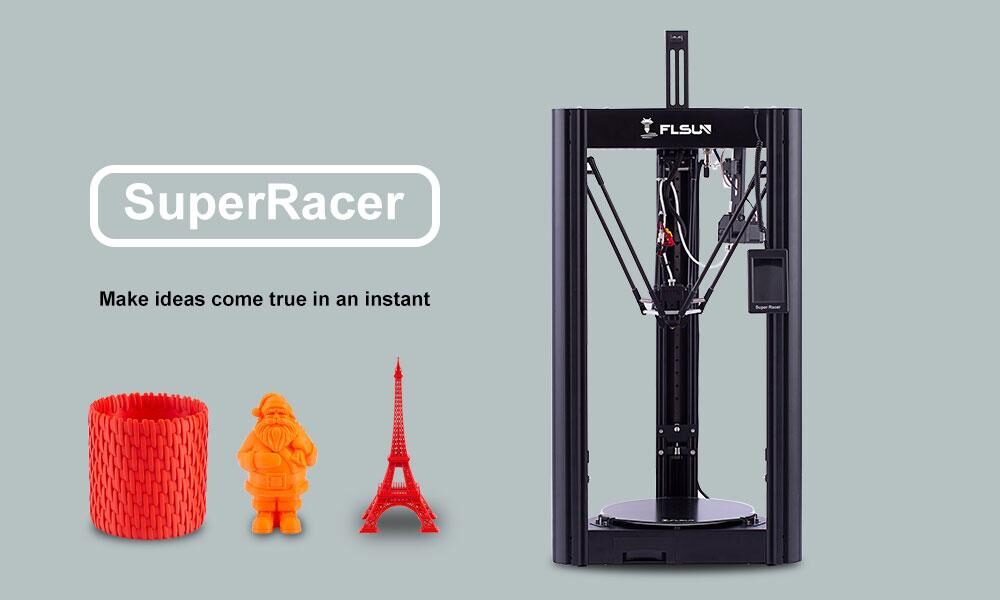
However, their newest model, Super Racer, caught the attention of many who wonder if it’s fast. The ads for this printer suggest it’s perfect for instantly turning ideas into reality.
Unfortunately, we all know 3D printing isn’t fast. Still, this printer’s potential print speeds of up to 200mm/s sparked my interest, so I bought the Super Racer.
After using this machine for a while, I decided to share my honest opinion to help people interested in this printer determine if it’s worth their time and money.
The new model has many features you can explore and a reasonable price, but can you expect the instant results they promise?
Let’s look at the FLSUN Super Racer and find out if it’s as fast as they claim.
Technical Specifications
- Brand: FLSUN
- Model: Super Racer
- CE Certification: ✓
- Size: 440x390x960mm
- Bed Temperature: 100°C
- Consumables Diameter: 1.75mm
- Printing Speed: 150mm/s
- Maximum Printing Speed: 200mm/s
- Color Print Speed: 150-200mm/s
- Slice Thickness: 0.2mm
- Slice Software: CURA/Repetier/Simplify 3D
- Interface Type: SD
- Filament: PLA/ABS/PETG/WOOD
- Precision: 0.05-0.3mm
- Power Supply: 24V
- File Format: OBJ/STL/AMF/3DS
- Auto Leveling: ✓
- Nozzle Diameter: 0.4mm
- Maximum Print Size: 260x260x330mm
- Molding Technology: FDM
- Connectivity: USB, USB cable, micro SD card
- Languages: English, French, German, Spanish, Russian, Japanese, Chinese, Taiwanese Mandarin
What’s in the Box?
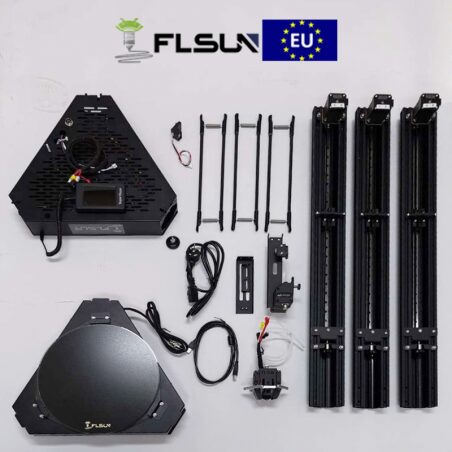
If you buy the Super Racer, you will get the following accessories:
- FLSUN Super Racer
- USB cable
- Power cable
- Scraper
- Grease tube (5G)
- Spare PFTE tube
- Spare heater and thermistor
- Spool holder
- Mini sool filament 200g
- Spare hotend
- Needle for nozzle
- Screws, wires, and zip ties
- 3D-printed clips
- Mini SD card 4 HB with a USB stick
- Clippers
- Hex wrenches
- User manual
How to Assemble the FLSUN Super Racer?
Assembling the Super Racer takes about 30-40 minutes. If you’re a beginner, don’t fret. The user manual and detailed guide included can help you assemble your toy easily.
Most budget-friendly printers don’t include good instructions for newbies. However, this brand ensured anyone could assemble their printers, including this one.
You might get overwhelmed by the many components when you open the package. The FLSUN Super Racer comes with many tools and spare parts.
Luckily, most come pre-assembled, so you can connect and screw the parts in less than 1 hour and start using your new 3D printer.
Here’s a quick step-by-step guide for beginners:
- Place the top shell on a flat surface.
- Take out the motor cables of the 3 axes.
- Install the axis.
- Plug the motor cable before putting the motor into the top shell.
- Fix with 4 M4x22 long screws.
- Install the other two axes in the same manner.
- Install the bottom case.
- The logo on the hotbed must remain in the same direction as the logo on the top shell.
- Fix with 4 M4x22 long screws.
- Fix the other two axes in the same manner.
- Slide the touchscreen bracket nut into the guide groove of the left axis.
- Fix the touchscreen bracket at 25 cm from the top shell.
- Attach the touchscreen to the bracket.
- Rotate the printer 180 degrees.
- Install the parallel arms.
- Install the effector module (the logo of the effector module should face forward).
- Connect the connector of the effector module to the main cable.
- The color of the connector should match.
- Install the main cable.
- Put the main cable into the groove of the axis.
- Install the extruder and filament detection sensor.
- Fix with 2 M4x8 short screws.
- Plug the filament detection sensor cable.
- Pass the extruder cable via the hole on the bracket and plug it into the extruder motor.
- Insert the PTFE tube into the extruder until it can no longer forward.
- Fix it with the gift buckle.
- Fix the main cable and the PTFE tube using the gift tie.
- Install the filament holder.
Finally, you should take care of the automatic leveling, and you’re all set for a test print.
FLSUN Super Racer Review
If you’re searching for a fine delta 3D printer made of high-quality components, consider Super Racer. When you get your hands on this unit, you will realize it’s sturdy and made with care by the manufacturer.
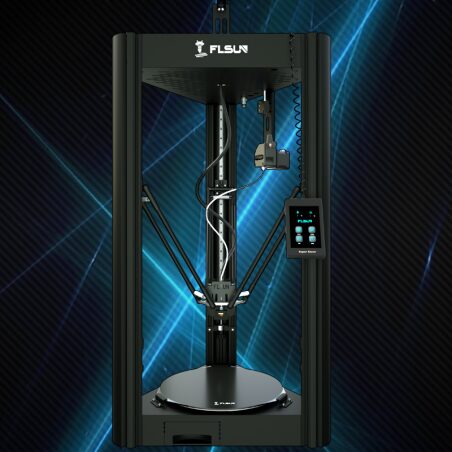
Many printers at this cost don’t feel well-made. So, you can expect a strong construction for about $450.
Additionally, it’s a user-friendly machine that doesn’t require adjusting things to get good prints. In other words, it’s easy to use right out of the box.
If you’re a beginner looking for a budget-friendly, stylish, and potentially fast printer, look no further than Super Racer.
FLSUN Super Racer has the potential for impressive results.
Let’s summarize the technical specifications of this machine before diving deep into the assembly, features, performance, and advantages and disadvantages.
Important Features
FLSUN has made 2 impressive delta 3D printers, the QQ-S and the Q5.
Their latest release, Super Racer, caught the attention of many because of the potential maximum speed (200mm/s).
I’ve had this 3D printer for a while now, and I will take you through the key features you can expect and share my thoughts on this low-cost delta printer, so let’s dive in!
Linear Rails and 10mm Belts
The linear rails help the unit reach high printing speeds without compromising accuracy. Additionally, they don’t produce a lot of noise during movement.
On the bottom of each rail, you can find a belt tensioning knob.
However, if you decide to adjust the knobs, having the same belt tension on each axis is crucial. Otherwise, you might experience dimensional accuracy problems for prints.
Also, these knobs aren’t simple to turn, as they’re recessed in the aluminum extrusion. However, considering that you won’t need to do this process frequently, you can ignore this small problem.
Lastly, this well-known 3D printer has 10mm belts, which aren’t GATES, but they’re still good. These belts help with fast motions during printing, so I hope more 3D printers will use broader straps in the future.
Carbon Fiber Rods
Typically, delta 3D printers provide better results with light moving parts. The rods consist of carbon fiber, so they’re light and stiff.
Moreover, each pair of carbon fiber rods stays in place with the help of 2 springs. The rods weigh only 177 grams and have plastic caps which will fall apart at some point.
The grease will minimize wear, but I’m certain that the plastic caps will deteriorate after thousands of hours of printing. The worst part? I couldn’t find any replacements online.
Hopefully, FLSUN will soon start selling replacements.
Super Racer Effector
The Super Racer includes a sturdy aluminum Super Racer effector, a V6 hotend clone, a heat block, and a nozzle. You will get 4010 radial fans with soft plastic ducts that send the air near the nozzle for part cooling.
The effector assembly, including the radial fans and hotend, weighs around 264 grams. The best part? The way it’s mounted to the arms makes the removal quick and easy for service of the hotend.
The removal takes seconds. Therefore, if you buy a spare effector, you can replace it in seconds and start printing without losing too much time.
BMG Extruder Clone
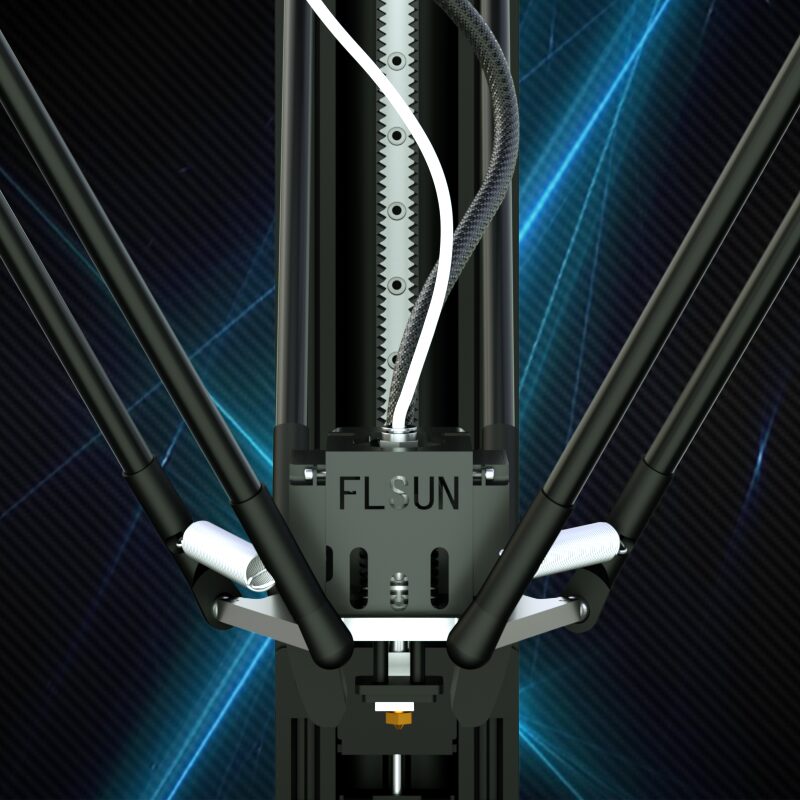
The Q5 printer by this brand has a Titan clone extruder. On the other hand, the newest model features a BMG extruder clone with a gear ratio of 3:1 and dual gears.
The dual gears help push the filament to the nozzle more efficiently.
A good extruder matters because you can’t print as quickly with a standard-style single-gear extruder.
Although it’s not the highest quality, you can still get great performance and accomplish excellent results with this extruder.
PTFE Lined V6 Hotend With Heat Block
The Super Racer has a regular V6 clone hotend with a volcano-like heat block.
The PTFE tube goes right up to the nozzle. Therefore, you shouldn’t push your printing temperatures over the limit. Otherwise, the tube will start degrading and releasing toxic fumes.
I prefer all-metal heat breaks over PTFE-lined ones. However, I don’t see this as a big issue because you can always upgrade without spending too much money.
For standard PETG and PLA printing, the stock one should suffice.
Additionally, the volcano-like heat block isn’t as long as the original, so the nozzle sticks out greatly, which isn’t good for consistent temperatures.
You can upgrade the hotend assembly with a bi-metal heat break and a regular Volcano nozzle that will make the most of this unit’s speeds.
Dual Air Ducts for Better Cooling
The great features of this model wouldn’t matter much if the part cooling didn’t perform properly. Luckily, this printer comes with dual-part cooling fans and ducts.
These parts perform great with larger models. However, I prefer having more airflow, as they limit the quality of fast PLA prints. The coats don’t get enough time to cool, causing low-quality results.
A pair of 5015 fans would perform much better with fast printing.
Magnetic Auto-Leveling Sensor
The Super Racer includes a removable magnetic auto bed leveling sensor. You can use this sensor after installing your machine.
It works great. Moreover, after doing the first calibration, there wasn’t a need for re-leveling.
The FLSUN Q5 has the same feature and works as great as the newest model.
I must say that most low-cost printers don’t include this feature, so having a detachable magnetic auto-leveling sensor was a surprise.
Moreover, the printer auto-levels, making things easier for people without experience in manual leveling.
Many people see FLSUN Super Racer and worry about the size, but they shouldn’t. It’s a larger printer, but the brand didn’t make it too heavy.
FLSUN made their delta 3D Super Racer with lightweight carbon fiber so that the print head doesn’t weigh much and matches the high print speeds of other delta printers.
32-Bit Motherboard With 4 Silent Stepper TMC2209 Drivers
The 32-bit motherboard of this unit appears familiar. However, it’s not a BIGTREETECH motherboard. The brand included a clone of the well-known SKR 1.3 board.
The stepper drivers feature large heatsinks and a 60mm fan for cooling, which provides excellent airflow while remaining silent.
Additionally, the stepper drivers have hot glue added on the side, which I don’t like.
Overall, there’s not much to say about this 32-bit board. If you’re familiar with SKR 1.3, you can expect the same performance and results.
Glass Print Surface
The FLSUN Super Racer’s aluminum heated bed has a textured glass print surface, like the FLSUN Q5 and other similar delta 3D printers.
The glass bed performs well, which is why it’s a popular choice among printers recently. When heated, the cover has excellent adhesion and helps prints pop off quickly after cooling down.
What I like the most is the insulation that covers the radius of the aluminum heated bed.
Cheng Liang 360W 24V Power Supply
The power supply you will get with this machine is a Cheng Liang unit. Although it’s not a bad option, it’s not my favorite because I have had a bad experience with this unit.
Nevertheless, the Super Racer draws only 230W at a time. Therefore, this power supply will suffice.
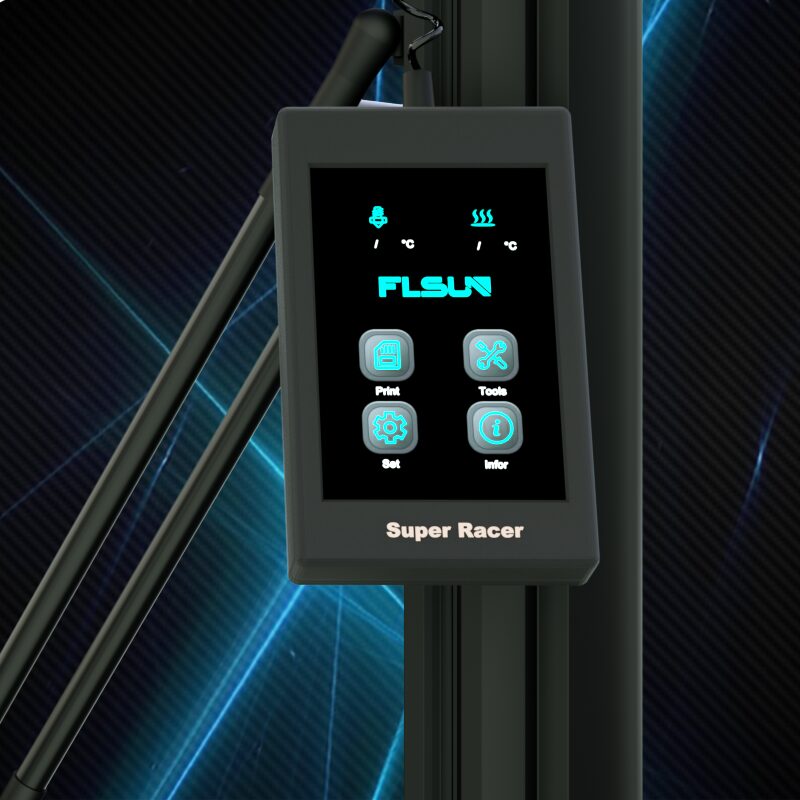
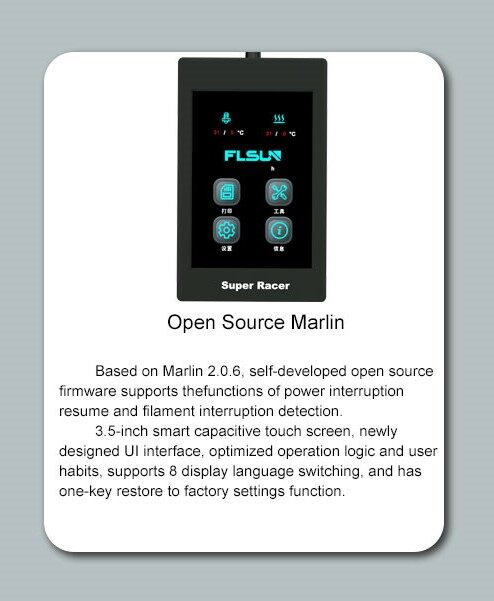
3.5-inch Touchscreen
What I like most about this unit is the detachable 3.5-inch touchscreen. You can quickly and easily install this touchscreen, so it’s great for beginners.
Magnetic support attaches to the unit to ensure the screen is easy to reach. I usually use the touchscreen in place without detaching it. However, I’m sure other users will find this feature useful.
Once you remove the touchscreen, you can use this feature as a smartphone.
Furthermore, the touchscreen isn’t complicated for newbies. On the contrary, it’s user-friendly with a simple feature set for operating the machine.
You can also view the print speed during work, which is a nice touch. I only worry about the cable connection on the top of the unit, which might deteriorate over time.
Many people like the removable touchscreen because it’s portable. Moreover, it is large enough to print efficiently and show the settings you want to change.
Other 3D printers have larger touchscreens. However, this one’s still excellent for good 3D printing.
FLSUN made this printer with convenience in mind. There’s also a removable print bed, so you can easily detach this part whenever necessary.
As I mentioned earlier, the adhesion is excellent, and you can quickly remove your prints when they’re done. FLSUN’s QQ-S Pro has the same features as Super Racer. So, you can’t go wrong with any of FLSUN’s units.
When testing this printer, I didn’t have to use a build surface, so I was impressed by the adhesion in the same way I was amazed by the performance of the QQ-S Pro.
Filament and Power Outage Sensors
Lastly, I would like to mention the sensors that will make your work easier. For instance, the filament run-out sensor detects when the filament’s running out and stops your print.
There’s also a print saving and resume option, ensuring your hard work isn’t ruined in case of a power cut.
Overall, the FLSUN Super Racer makes a great printer. You will get this beauty pre-assembled. So, if you’re a beginner with basic knowledge of delta 3D printers, you will assemble this printer in about 30-45 minutes.
You should only assemble the rods connecting the frame’s top portion and the print bed. Once you’re done building the parts, you can auto-level and start printing.
Unfortunately, this printer doesn’t provide WiFi printing or connectivity, but you can use a USB stick or SD card, so don’t worry about this downside.
Now, let’s discuss the performance of this popular delta 3D printer and determine if it’s a good investment.
Performance
Out of the box, the Super Racer performs well and delivers fast and impeccable results. Therefore, the name reflects the fast performance of this printer!
I made regular prints faster than a standard cartesian 3D printer or CoreXY. If the slicer profile’s tuned well, your FLSUN Super Racer can reach print speeds of about 80mm/s without tinkering.
However, if you’re trying speeds of over 80mm/s, part cooling doesn’t offer good results, especially for smaller PLA prints.
You can push the printer over 100mm/s for PETG and ABS.
However, you will experience ringing. With the Marlin firmware, ringing appears at these speeds and calls for jerk tuning and acceleration for satisfactory results.
You should install Klipper firmware to use Input Shaper to improve your print quality at high speeds.
Remember that I’m discussing the “actual” speeds you can get with this printer. You can increase the speed to the maximum and keep low acceleration values.
However, that doesn’t mean your Super Racer is working at those speeds, although your touchscreen says otherwise.
Design and Construction
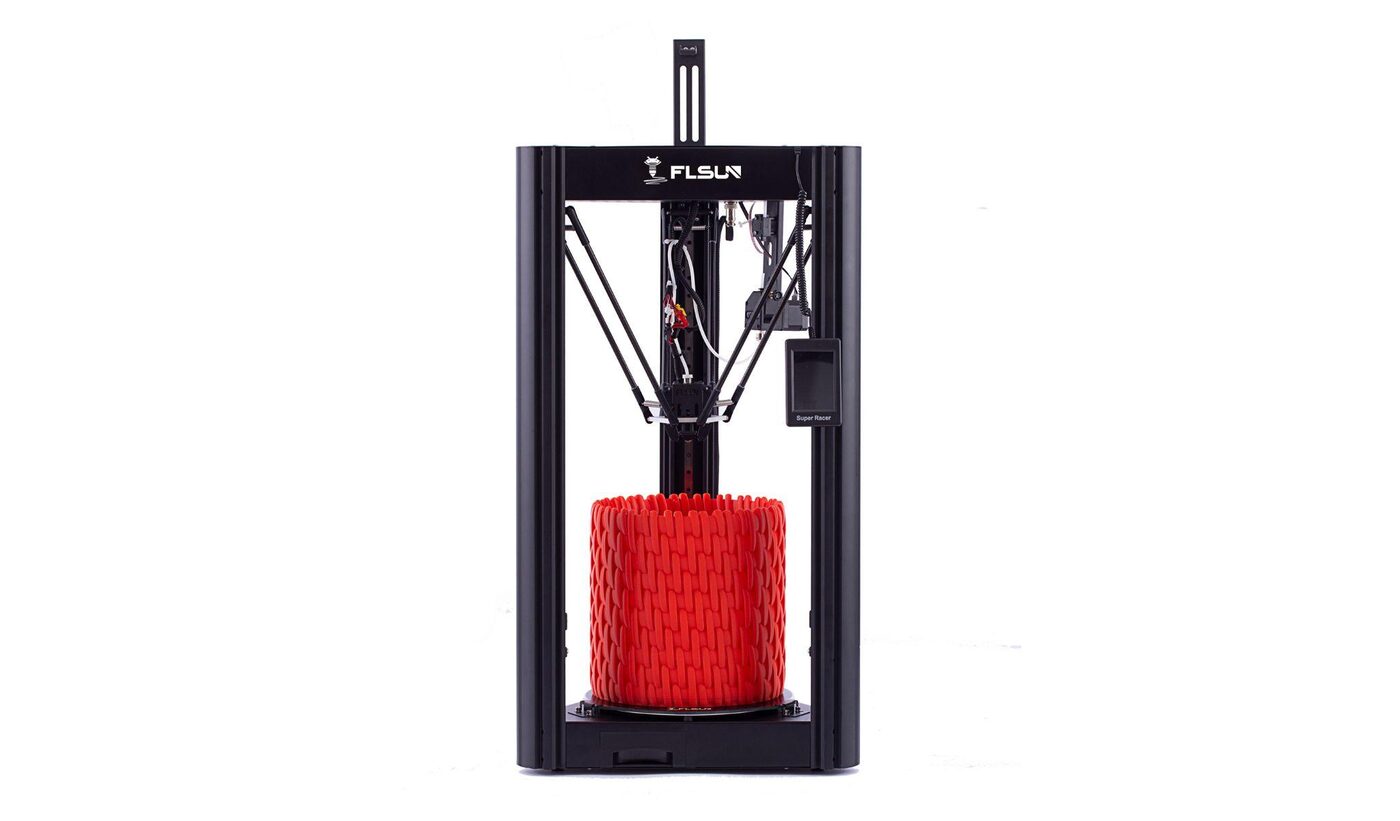
FLSUN has built a delta 3D printer, which looks and prints excellently out of the box.
This printer has a sturdy construction. However, it’s still lightweight, stylish, and easy to assemble in under 1 hour.
Overall, the printer justifies the name “Super Racer” because you will get perfect results at high speeds.
The slicer is a dated version of Cura with tuned-in profiles. So, if you’re searching for a delta 3D printer that provides good results at high speeds, consider FLSUN’s latest model.
This printer deserves bigger cooling fans because, with better cooling, this printer would perform even faster without compromising the quality of the prints.
You can upgrade your printer over time. Just give yourself enough time to play with your new toy, so you can determine the parts you could improve.
I love my FLSUN Super Racer and believe it’s worth your time and money!
Now, let’s review this printer’s heating time and power consumption before I summarize the pros and cons and wrap up this article.
Heating Time
I’ve done a few test prints for the heating time for the hotend and heat bed, and here’s what I found:
Hotend – 200C in 1 minute and 35 seconds and 250C in 2 minutes and 10 seconds.
Heatbed – 60C in 2 minutes and 30 seconds and 100C in 7 minutes and 20 seconds.
Power Consumption
The FLSUN Super Racer takes up to 17 watts in standby mode. This printer needs over 220 watts to heat the print bed and nozzle. While printing, this unit needs between 120 and 150 watts.
Noise Levels
Unlike FLSUN Q5, the Super Racer’s fans operate quietly, so this brand’s latest model is quieter than the previous ones.
The hotend fan starts working after you begin heating the hotend. The rest of the fans in this printer stay quiet. So, I’m happy to confirm that this new printer’s one of the quietest on the market.
But here’s the kicker – FLSUN found a way to reduce vibrations by applying cork gaskets between the stepper motor and the frame!
FLSUN Super Racer Pros and Cons
If you buy the FLSUN Super Racer, you will get a well-made delta 3D printer with many features and hardware that performs exceptionally.
I’m not saying it’s the perfect printer. I agree with people who say that some of the parts need improvement. Luckily, you can upgrade these parts later.
If you set up Linear Advance or install Klipper, you will notice the print speed and quality improvement at higher rates. Input Sharper will remove the ringing.
Moreover, you can upgrade the part cooling fans and push the print speed even further without compromising the quality of your prints.
Now, let’s summarize the pros and cons of the FLSUN Super Racer.
Pros
- A budget-friendly, lightweight, and stylish printer
- The printer has automatic print bed leveling.
- The FLSUN Super Racer can print at a great pace.
- You can assemble this delta 3D printer in under 1 hour.
- You can get excellent print details at slower speeds.
- The package includes many tools and spare components.
- Sturdy construction and well-made parts
- Detailed instructions for beginners
Cons
- No PEI print bed
- Fine-tuning required for good prints
- The provided print profile doesn’t work.
- The printer isn’t suitable for flexible filament.
- There’s a micro-SD slot on the side.
- Underperforming fans
Is FLSUN Super Racer Worth it?
I think FLSUN’s latest release, Super Racer, will meet the needs of anyone interested in 3D printing, especially beginners.
I say it’s great for newbies because it’s affordable, easy to install, user-friendly, and has many features.
With the FLSUN Super Racer, you will get unique prints quickly. Usually, the print speed you get with this printer depends on what you’re printing. In other words, the print speed is limited only by the material you’re using.
I also have to mention the underperforming fans. They also limit the print speed, but you can upgrade your fans in the future.
Other than the lack of cooling, there’s not much I can complain about when working with FLSUN Super Racer. To offer people this quality and print speed for less than $500 isn’t a small achievement, so I can only congratulate FLSUN on their final product.
Lastly, I would like to thank FLSUN for including the build quality of this machine. I love the radio-like touchscreen because it’s convenient and portable!
You can see that FLSUN put a lot of thought and care into designing this unit and came up with a beautiful, eye-catching 3D printer.
In a nutshell, it’s a well-built 3D printer that provides great value for the money!
Final Thoughts
The latest release by FLSUN, Super Racer, comes at a low cost and has many features you can enjoy. I think it’s one of the best delta printers on the market.
One of the biggest advantages of this printer over other delta printers is the high print speed. The default printing speed is 150mm/s. However, the maximum printing speed is 200mm/s.
The performance at fast printing speeds is still good, and compared with other standard 3D printers, printing the same thing can save about half of the printing time.
This printer features a 32-bit high-speed motherboard with 4 TMC 2209. It’s more stable and quieter than other delta printers with higher printing accuracy. This machine has the potential to work fast. However, I suggest taking things slower to create high-quality prints and get the most out of this printer.
The biggest downside is the underperforming cooling. FLSUN could have done a better job in the cooling department, but you can upgrade the fans in the future.
Some say they’ve experienced problems with the bed adhesion, but I didn’t have issues with this feature, so I can’t support their claim.
I also have to mention the magnetic bed, which is hard to remove. You have to unscrew 6 screws whenever you want to remove the bed. I would have preferred a detachable one for convenience.
However, considering the price and all the features you get for that price, I honestly feel bad complaining about such minor inconveniences.
In a nutshell, it’s a high-quality 3D printer you won’t regret buying!

Recommended Reading
Best FLSUN SR Cura Profile & Settings
Are you thinking of downloading Cura to your FLSUN Super Racer 3 printer and wondering what the best profile and settings are? Find out here!
How To Install Klipper on FLSUN SR (Super Racer)
Installing Klipper on your FLSUN Super Racer printer isn’t as straightforward as any old computer-based installation, so if your experience with 3D printing and firmware ...
How to Update FLSUN Super Racer Firmware?
If the time has come to update your FlSUN Super Racer (SR) firmware, this article shows you how to do just that quickly and easily.